
Psychological Safety at Work: The Hidden Driver of High Performance in UAE Teams
Walk into most high-performing teams and you won’t immediately see what makes them different. The org chart looks the same. The tools look the same. The targets look the same.
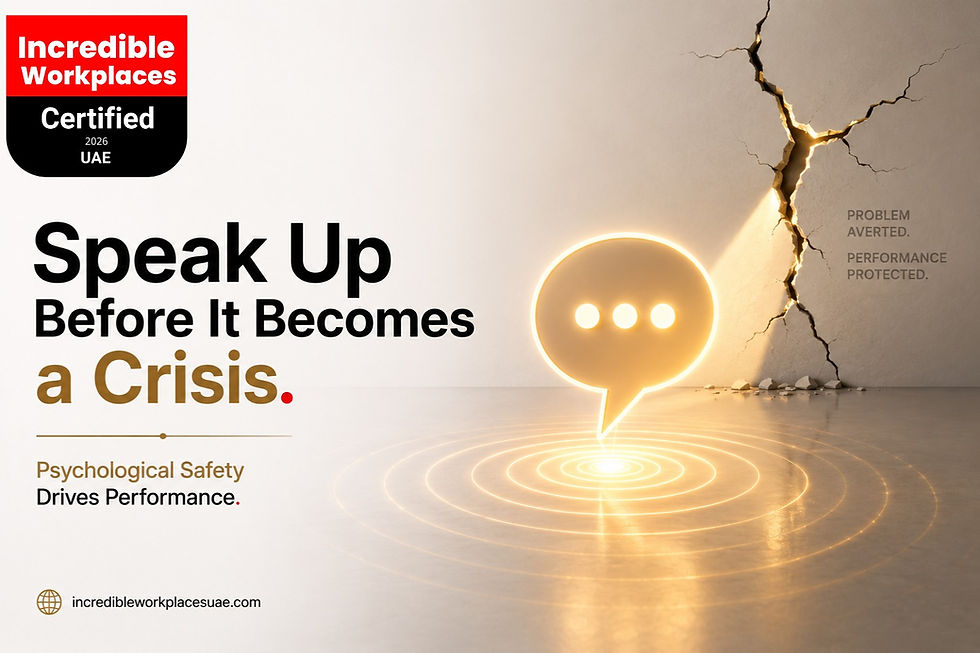
What’s different is invisible — and it shows up the moment something goes wrong. In a high-performing team, someone says “I think we have a problem” before it becomes a crisis. In a low-performing one, everyone already saw it coming and nobody said a word.
That difference has a name: psychological safety at work. And in the UAE’s fast-moving, multicultural business environment, it may be the single most underestimated driver of team performance.
Not because leaders don’t value it. Because most have never deliberately built it.
What Psychological Safety Actually Means
Psychological safety is the shared belief that it’s safe to take interpersonal risks within a team — to ask a question that might sound obvious, admit a mistake, challenge a senior colleague’s idea, or propose something that might not work.
It has nothing to do with comfort or avoiding hard conversations. The opposite, in fact. Psychologically safe teams have more disagreement, not less — because people trust that conflict over ideas won’t turn into conflict over relationships or careers.
Psychological safety isn’t about being nice. It’s about being honest without fear.
Teams without it look calm on the surface. Underneath, people are quietly editing themselves — holding back the question that needed asking, the concern that needed raising, the idea that needed testing.
Why This Matters More in UAE Teams Specifically
The UAE workplace brings together professionals from dramatically different cultural backgrounds, communication norms, and hierarchies of authority — often within a single team.
This diversity is a genuine asset. It also makes psychological safety harder to build by default, because different cultures carry different relationships with hierarchy, disagreement, and speaking up to senior leaders. An employee raised in a culture of deference to authority may interpret “speak up if you disagree” very differently from a colleague raised in a more direct communication style.
Add the pace of business in the UAE — ambitious targets, rapid growth, constant change — and the cost of silence increases. Fast-moving organisations cannot afford a culture where problems surface late because people were afraid to name them early.
Building a genuinely high-performance workplace UAE leaders can be proud of means actively designing for psychological safety across cultural lines — not assuming it will emerge naturally from a diverse, well-intentioned team.
The Business Case: What Psychological Safety Actually Drives
This isn’t a soft people metric. Psychological safety has a direct, measurable line to business outcomes.
– Faster problem-solving, because issues surface while they’re still small and inexpensive to fix
– Stronger innovation, because people share half-formed ideas rather than waiting until they’re certain — and most good ideas start half-formed
– Better decision-making, because dissenting views are heard before a decision is finalised, not after it fails
– Higher employee engagement UAE organisations consistently report when teams feel genuinely heard
– Lower attrition, because feeling unable to speak up is one of the most common reasons high performers quietly disengage and leave
Organisational research consistently identifies psychological safety as the single strongest predictor of team effectiveness — ahead of talent, resources, or strategy clarity.
What Quietly Erodes Psychological Safety
Psychological safety rarely collapses dramatically. It erodes through small, repeated signals:
– A question met with visible irritation instead of genuine engagement
– Mistakes followed by blame rather than a conversation about what to learn
– Senior voices dominating meetings while junior or quieter team members are rarely asked directly for their view
– Feedback that only flows downward, never upward to leadership
– Visible favouritism toward employees who agree rather than those who challenge constructively
Each instance seems small on its own. Repeated often enough, they teach a team exactly how much honesty is actually welcome — regardless of what leadership says it wants.
How Leaders Build It Deliberately
Model vulnerability first
Leaders who openly acknowledge their own mistakes or uncertainty give everyone else permission to do the same. Psychological safety is rarely built from a memo. It’s built by what leaders do when something goes wrong in front of the team.
Ask before you tell
In team discussions, deliberately invite input before sharing your own view — especially from quieter or more junior voices. Once a senior leader states an opinion, genuine disagreement becomes much harder for everyone else in the room.
Separate the idea from the person
Respond to weak ideas with curiosity, not dismissal. “Tell me more about that” keeps the door open for the next idea. A visible eye-roll closes it for good.
Treat mistakes as data, not character flaws
How leadership responds to the first mistake sets the tone for whether the next one gets reported immediately or hidden until it’s a much bigger problem.
Make space for every voice intentionally
In multicultural teams, this often means directly inviting input from people who may be culturally inclined to wait their turn — rather than assuming silence means agreement.
The Bottom Line
Psychological safety at work isn’t a wellness initiative. It’s the operating condition that allows everything else — innovation, speed, honest feedback, genuine collaboration — to actually happen.
In the UAE’s diverse, high-velocity business environment, the organisations that build it deliberately will out-think, out-adapt, and outperform the ones that simply hope it shows up on its own.
Is Your Team Truly Safe to Speak Up?
Incredible Workplaces UAE helps organisations assess psychological safety, strengthen leadership behaviours, and build the high-trust culture that drives real performance.
– Assess your workplace culture and understand how safe your teams genuinely feel to speak up
– Benchmark leadership effectiveness against high-performing organisations in the UAE
– Pursue Incredible Workplaces Certification and build a culture that retains and attracts top talent


Comments